Hardware + software
Integrated systems
Designing musical tools where the physical interface, software logic, and artist instinct behave like one instrument.
Jamie Malz designs integrated systems that remove friction between gear and performance, so musicians can reach a sound only they could make.

About
Born and raised in Montreal, Jamie Malz moved from studies in engineering, marketing, and finance into Berklee College of Music's Electronic Production and Design department. He sees music as more than an art form: it is a real-world environment for understanding behavior, decisions, and the mechanics of ideas in motion.
While many focus on the final performance, Malz is drawn to what happens under the hood. His work bridges technology and performer intuition, combining business, engineering, and music technology into systems that make creative choices faster, simpler, and more personal.
What Jamie builds
Hardware + software
Designing musical tools where the physical interface, software logic, and artist instinct behave like one instrument.
Performance-first UX
Removing the tiny points of resistance that pull musicians out of flow and back into menu-diving.
Identity over presets
Building technology for artists who want systems that reveal their voice instead of flattening it.
Behavior in real time
Treating music as a live environment for understanding decisions, constraints, feedback, and invention.
Selected work
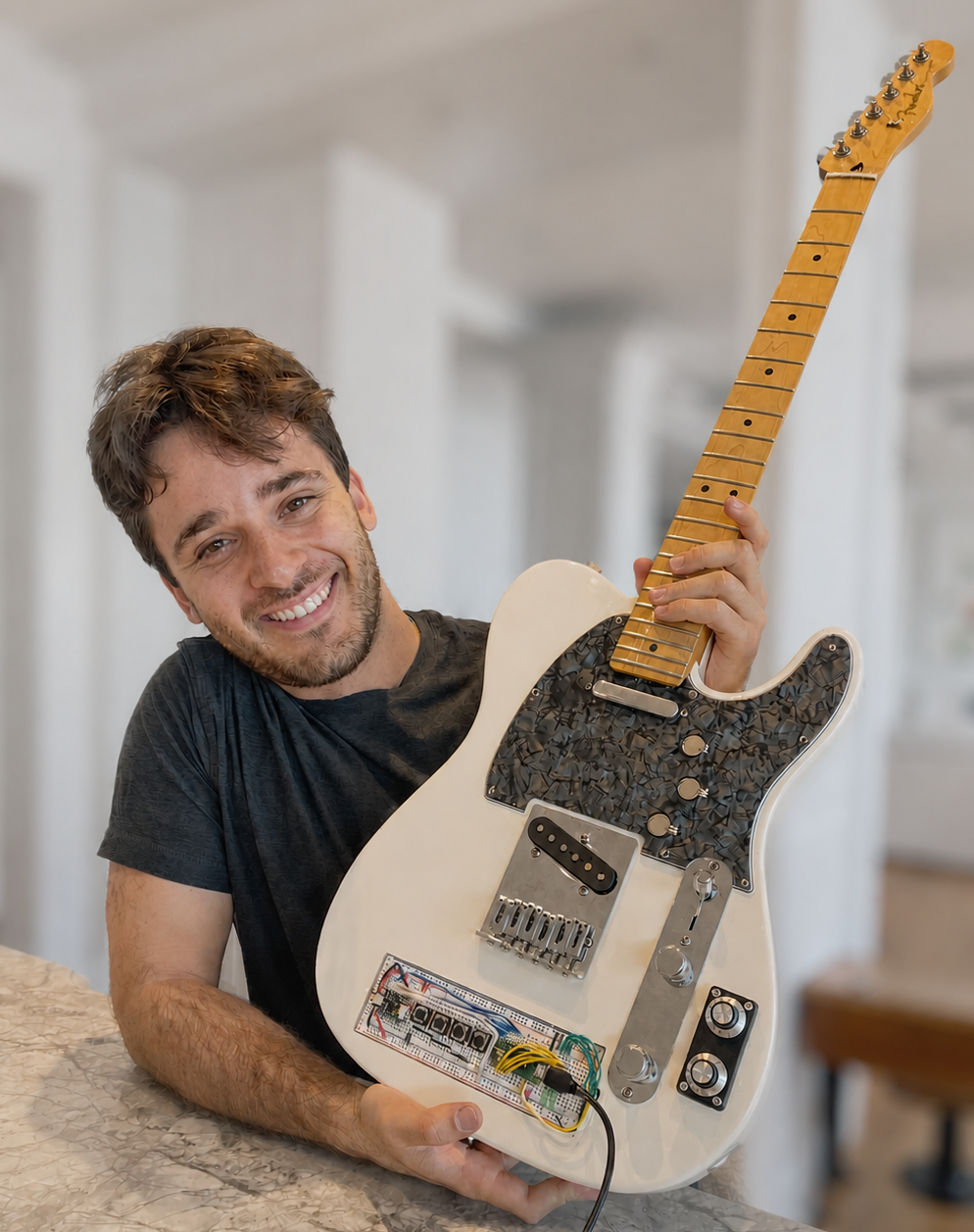
A modified Fender Telecaster with a custom breadboard and microcontroller mounted directly to the body, turning a familiar instrument into a programmable performance interface. The circuit routes button input into expression that the player can map, remap, and rebuild on the fly.
Design principles
Simplify complexity until the tool disappears.
Bridge the gap between gear and performer intuition.
Find small design changes with disproportionate creative impact.
Connect unrelated ideas until a new instrument emerges.
Journey
A childhood spent building remote control planes, cars, boats, and jets shaped a lifelong comfort with mechanics, systems, and performance.
Studies across engineering, marketing, and finance sharpened the way Jamie approaches creative technology as both product and problem.
At Berklee College of Music, Jamie brought complex problem solving into Electronic Production and Design.
Focused on companies and products that help musicians find a sound that could only belong to them.
Send a note about collaborations, product conversations, instrument design, or music technology opportunities.